About
The Junction
One flood. Nine hard questions. How far does your rule hold?
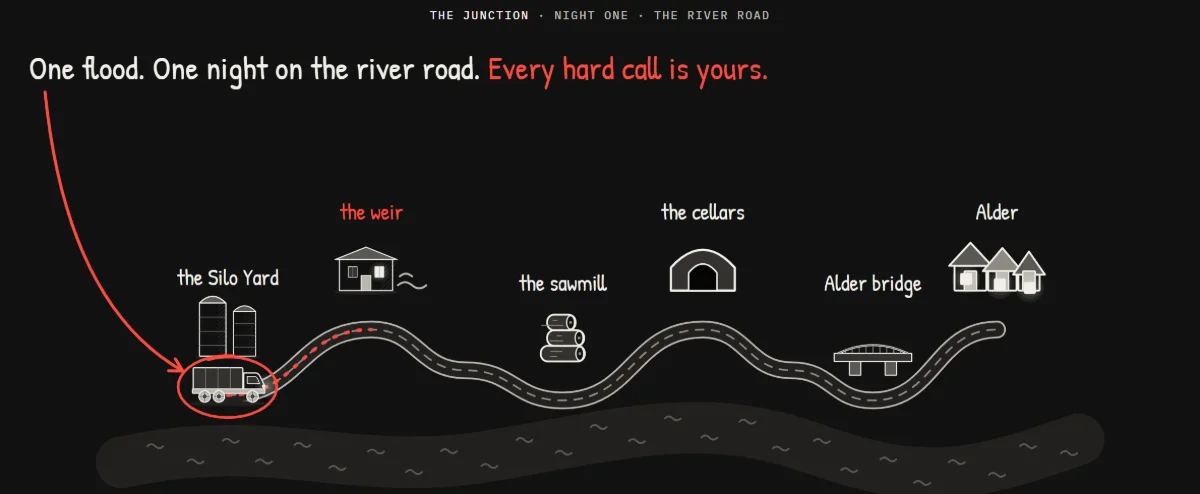
One night, one road, and then three weeks of flood: every hard call in the valley is yours. The first comes from the trolley problem: a runaway wagon at the Silo Yard, five people on the line, one on the side track, and your hand on the lever.
Before each journey the game asks for your rule, in one sentence. Then it tests it. After a call that bears on your rule, it tells you whether you kept the rule or left it. Neither is marked right.
Then you take the river road, and the same question keeps arriving as a different thing. Flood water, and a child on the stones. Logs in a flume, and a large man beside you. A cask loose in a cellar, and a man who says yes, or no. Someone asks what you would do if it were you. Each time, the game looks at what your answer does.
There is no clock and no score, and no answer is marked right. After a call the game asks you one question about the turn you just made. Where a call leaves the result to chance, you flip the coin yourself. At the end of the first journey it gives you back the rule you followed, in one sentence.
Three weeks after the flood, an inquiry opens the record. It reads your rule back to you. It puts two of your own calls side by side, two that point opposite ways, and asks which one is your rule. You may stand by both, and when you say why, it asks you one question back. Then it asks you to bet on what a real study found, and shows you the study.
When all nine journeys are done, the inquiry sits a last time. It shows the valley as you left it, sets each of your rules beside the calls that tested it, and asks which rule comes first. Its report is the last page.
Beyond the valley are three rooms of real cases: the Archive, the Lab and the Bench. A Soviet officer with five missiles on his screen. Engineers the night before a launch. A court asked whether a starving man may kill. You make the call, bet on what was done or on what came of it, and then read what happened, with its source. A new file opens every week.
Play The Junction Free. No account. It runs in your browser.
How a scene works
- The story is drawn, one line at a time. Tap, and a new handwritten line appears with an arrow to what it is about.
- You make the call. The drawing shows what your choice does.
- The question comes back as something new. On the first journey’s night road it arrives at the next place as a different thing; in the other journeys the same scene returns with one fact changed. What is new is marked NEW in red. Does your rule still hold?
- The game asks you one question about the turn you just made. It does not tell you what to think.
- Some calls are gambles. Then you flip the coin yourself, see how it came out, and are asked whether you would make the same call again.
- Some journeys end by turning the question round, so that the rule you used on someone else is used on you.
Questions
What is The Junction?
A free game about hard decisions, played in a web browser. Each scene is a line drawing, told in handwriting one line at a time. You make the call, the drawing shows what it does, and then the question comes back with something new, marked NEW in red. There are nine journeys. A first run plays sixty calls; the long nights hold fifty-one more.
Is it the trolley problem?
Only at the start. The first journey is one night on one road. Its first call, at the Silo Yard, comes from the trolley problem; then the same question keeps arriving as something else down the river road: eight calls on the main line, each a different thing happening at a different place, and fifteen in the long night. The other eight journeys ask different questions: whom you save first, what is a fair share, what risks you accept, when a lie is right, when you may decide for someone else, when to obey, what people deserve, and what would change your mind.
Is there a right answer?
No. No choice is marked correct, there is no clock and there is no score. After a call you can see how eleven schools of thought weigh it, and the game asks you a question about the turn you made. It does not tell you what to think. The one thing set against a fact is your guess about what a published study found, and the game shows you the study.
What is “your rule”?
At the door of each journey the game asks for your rule, in one sentence: “I take what is certain”, say, or “I take the chance when the prize is bigger”. You may also say you have no rule. The calls inside then test it, and after each one the game tells you whether your call kept your rule or left it. Keeping a rule is not marked right, and leaving one is not marked wrong.
What is the inquiry?
After each journey, an inquiry reads the record. If a call left the rule you stated, it reads the rule back and asks whether it stands. It takes two calls you made that point opposite ways and asks which one is your rule. You can stand by both, or take one back, and say why: tap a reason and it asks you one question back. Taking a call back changes nothing you did, and the record keeps both. Then you bet on what a real study found, and the game shows you the study and its source.
Does it have an ending?
Yes. When all nine journeys are finished, the inquiry sits a last time, one year after the flood. It shows the valley as you left it, sets each of your rules beside the calls that tested it, and asks which rule comes first. Its report is the last page, and you can share it.
How long is it?
The main line is sixty calls in nine journeys, six to eight calls each. When you finish a journey you can play its long night: the whole journey, twelve or fifteen calls. A new game opens on one real case, which takes about ninety seconds. The case files take about two minutes each.
Are the case files true?
Yes. Every case file is a real case, told from where the person who decided stood, and each one names its source. You make the call, bet on what was done or on what came of it, and then read what happened. A new file opens every week. A call that differs from history is not marked wrong: the people in these files did not always get it right.
Is it a personality test?
No. The record at the end describes the choices you made, in your own calls. It does not name your motives, grade you, or claim to measure a trait.
What happens to my answers?
They are saved on your own device. When you answer a scene for the first time, the game sends which scene and which choice to goodenomics.com, and the site adds one to a total. It does not send your name, an account, a device number, the time, or the order you played in. A switch in the menu turns this off.
Can I play it with a class or a team?
Yes. One screen runs a live room; phones join by scanning a code. The room takes no names, and the big screen shows only totals.
Where do the dilemmas come from?
Many scenes adapt well-known questions from moral philosophy and the study of judgment. The evidence pages say what each study found, with its source. The versions with family, age, consent and combined pressures are new comparisons written for this game, and no population percentages are claimed for them.
Who made it, and how?
It is directed by the owner of goodenomics. The words, the code and the drawings were made with Claude, an AI system from Anthropic, under his direction. The page How this was made says what has been checked, and what has not.
Does it cost anything, and does it work on a phone?
It is free, with no advertising, and it runs in the browser on a phone, a tablet or a computer. You do not need an account.
The nine journeys
- The JunctionWhom would you sacrifice?
- The RescueWhere does your circle end?
- The DistributionWhat does fairness require?
- The HospitalWhat risks will you accept?
- The RadioWhen is a lie right?
- The GateWho decides for them?
- The ReconstructionWhen should you obey?
- The CourtWhat do people deserve?
- The ReviewWhat would change your mind?