Journey 9 of 9 · Week three · 10:00 · Alder public inquiry
The Review
What would change your mind?
Three weeks later, a public inquiry asks how the flood was handled. A mother in tears says the water tablets made her daughter ill, and the hall wants them stopped. A mayor caught lying twice sends a warning that may be true. A crew has dug a tunnel for three weeks, and two of them died doing it; now a surveyor finds a faster way from the other side.
Seven calls about evidence: what a number does to your guess, what a positive test means, when to stop, and who hears it first when the record is about your own family.
Play The Review Free. No account. Your place is saved on your device.
How it opens
The first scene, in the game’s own words. In the game each line is written into the drawing as you tap.
- Three weeks later. A public inquiry is asking how the flood was handled. You are called to speak.
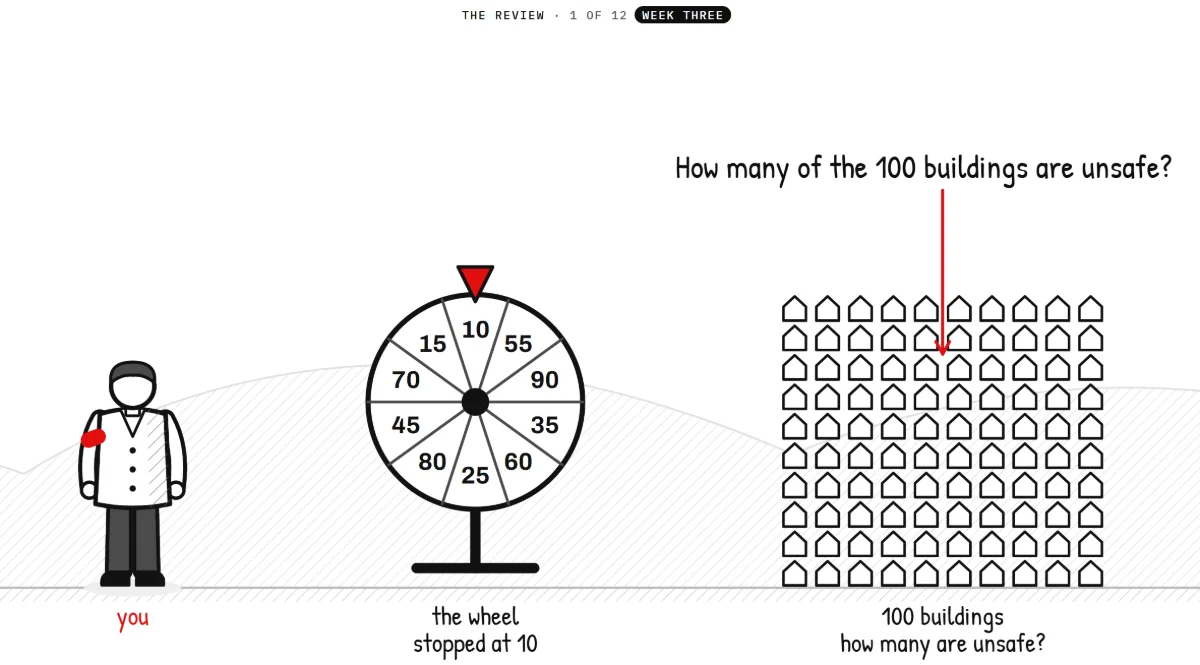
- First, a tradition: an old flood wheel is spun for luck. It stops at 10. It means nothing.
- Then the first question. The valley has 100 buildings like these. How many did the flood leave unsafe?
- Nobody has inspected them yet. You have no evidence. Just give your best guess.
How many of the hundred buildings do you estimate were unsafe?
The seven calls
After the first, each call changes one fact.
- A number before the evidence
- The accusation
- One medal
- The tunnel they bled for
- Her name on the list
- The barrier on the weir
- Who tells him
The long night
When you have finished the journey you can play it whole: all twelve calls. These are the other five.
- One story, four thousand records
- The liar’s warning
- The street you can see
- What is another check worth?
- The third warning
It happened
The valley is invented. This is not: The Stanford prison experiment: would you have stopped it?
What the research says
This journey adapts questions that have been studied. These pages say what the studies found, with their sources.
- The identifiable victim effect: one voice against manyOne named person moves us more than a number, however large the number.
- In-group favouritism: your people firstPeople favour their own group even when the group was made up a minute ago.
- Conformity: when everyone else gives the wrong answerThe Asch line experiments: how often people went along with a group that was plainly wrong.
- Anchoring: the number you saw firstA number from a spun wheel moves the estimates of people who know it means nothing.
- Base-rate neglect: what a positive test really meansA test with a 5% error rate comes back positive. The chance it is right can be about 2%.
- The sunk cost effect: finishing what should be stoppedSpending more because of what has already been spent.
Play The Review Free. No account. Your place is saved on your device.