The evidence
The identifiable victim effect: one voice against many
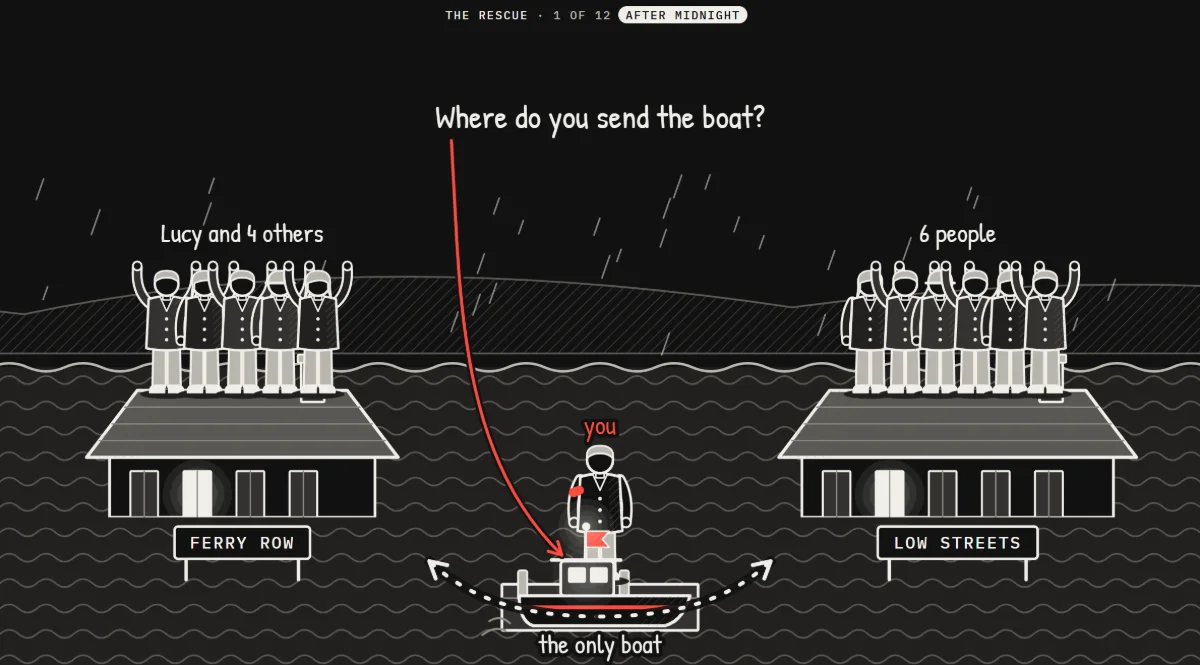
One person with a name and a voice moves us more than a statistic about thousands. It is the reason an appeal shows you one child, and the reason a rescuer may turn the boat toward the voice on the radio.
Identifiable victim effect
People give more to one named, described person than to the same cause described through statistics about many people.
What the study found
In Study 3 of a 2007 paper, people who had just been paid $5 gave an average of $2.38 to Rokia, a named seven-year-old girl, against $1.14 to an appeal built on statistics about millions facing hunger. Showing Rokia together with the statistics cut giving to her to $1.43 (159 people in all).
Source: Small, D. A., Loewenstein, G., & Slovic, P. (2007). Sympathy and callousness: The impact of deliberative thought on donations to identifiable and statistical victims. Organizational Behavior and Human Decision Processes 102(2), 143-153. doi.org/10.1016/j.obhdp.2006.01.005
Identifiable victim effect (the statistical half)
An appeal built on large numbers draws less giving than one named person does, even though it describes far more need.
What the study found
In the 2007 study, people who had just been paid $5 gave an average of $1.14 to an appeal describing food shortages affecting millions (more than three million children in Malawi among them), against $2.38 to a single named girl, Rokia (159 people in all).
Source: Small, D. A., Loewenstein, G., & Slovic, P. (2007). Sympathy and callousness: The impact of deliberative thought on donations to identifiable and statistical victims. Organizational Behavior and Human Decision Processes 102(2), 143-153. doi.org/10.1016/j.obhdp.2006.01.005
Compassion fade
Feeling, and giving, can fall as the number of people in need rises, beginning with the second person.
What the study found
Västfjäll, Slovic and colleagues measured feeling and giving for children in need, one at a time and in pairs. Feeling and giving were greatest for a single child; in the authors’ words, the decline ‘may begin with the second endangered life’.
Source: Västfjäll, D., Slovic, P., Mayorga, M., & Peters, E. (2014). Compassion fade: Affect and charity are greatest for a single child in need. PLoS ONE 9(6), e100115. doi.org/10.1371/journal.pone.0100115
How to read this
These are the answers of particular people, asked in a particular way, at a particular time. A share of people is not a verdict: it tells you what they answered, not what is right.
Where the game asks it
The Rescue (Where does your circle end?), The Hospital (What risks will you accept?), The Review (What would change your mind?). The game’s versions with family, age, consent and combined pressures are new comparisons written for it. They are not copies of the experiments, and no population percentages are claimed for them.
Play The Rescue Free. No account. Your place is saved on your device.
More evidence
- The trolley problem: what people actually answer
- The framing effect: lives saved or lives lost
- In-group favouritism: your people first
- The ultimatum game: would you refuse an unfair offer?
- The dictator game: what people give when nobody can refuse
- Third-party punishment: paying to punish a stranger
- Omission bias: the harm you cause and the harm you allow
- Obedience to authority: the Milgram experiments
- Conformity: when everyone else gives the wrong answer
- Anchoring: the number you saw first
- Base-rate neglect: what a positive test really means
- The sunk cost effect: finishing what should be stopped
- The default effect: when doing nothing is the choice