The evidence
The ultimatum game: would you refuse an unfair offer?
Someone else splits a sum between the two of you. You can take what they offer, or refuse, and then neither of you gets anything. Refusing an unfair offer costs you, and many people do it anyway.
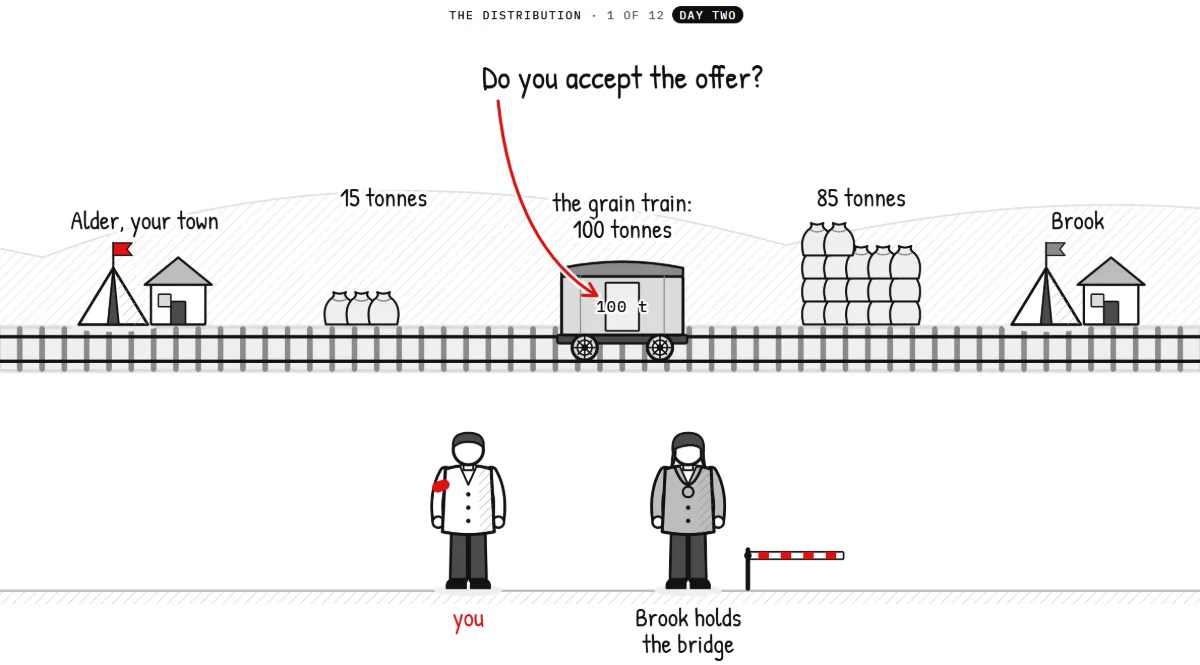
The ultimatum game
A purely self-interested responder takes any offer above nothing, since refusing leaves both with nothing. Many people refuse an offer they judge unfair, and pay for it.
What the study found
Across 75 results from 37 papers, proposers offered 40% of the money on average, and 16% of all offers were refused. In a review of the early experiments, Camerer and Thaler reported that offers below 20% are frequently rejected.
Source: Oosterbeek, H., Sloof, R., & van de Kuilen, G. (2004). Cultural differences in ultimatum game experiments: Evidence from a meta-analysis. Experimental Economics 7(2), 171-188. econpapers.repec.org/RePEc:kap:expeco:v:7:y:2004:i:2:p:171-188
How to read this
These are the answers of particular people, asked in a particular way, at a particular time. A share of people is not a verdict: it tells you what they answered, not what is right.
Where the game asks it
The Distribution (What does fairness require?). The game’s versions with family, age, consent and combined pressures are new comparisons written for it. They are not copies of the experiments, and no population percentages are claimed for them.
Play The Distribution Free. No account. Your place is saved on your device.
More evidence
- The trolley problem: what people actually answer
- The framing effect: lives saved or lives lost
- The identifiable victim effect: one voice against many
- In-group favouritism: your people first
- The dictator game: what people give when nobody can refuse
- Third-party punishment: paying to punish a stranger
- Omission bias: the harm you cause and the harm you allow
- Obedience to authority: the Milgram experiments
- Conformity: when everyone else gives the wrong answer
- Anchoring: the number you saw first
- Base-rate neglect: what a positive test really means
- The sunk cost effect: finishing what should be stopped
- The default effect: when doing nothing is the choice