The evidence
Third-party punishment: paying to punish a stranger
You were not cheated. You only watched someone treat a stranger unfairly. Punishing them will cost you, and nobody will thank you.
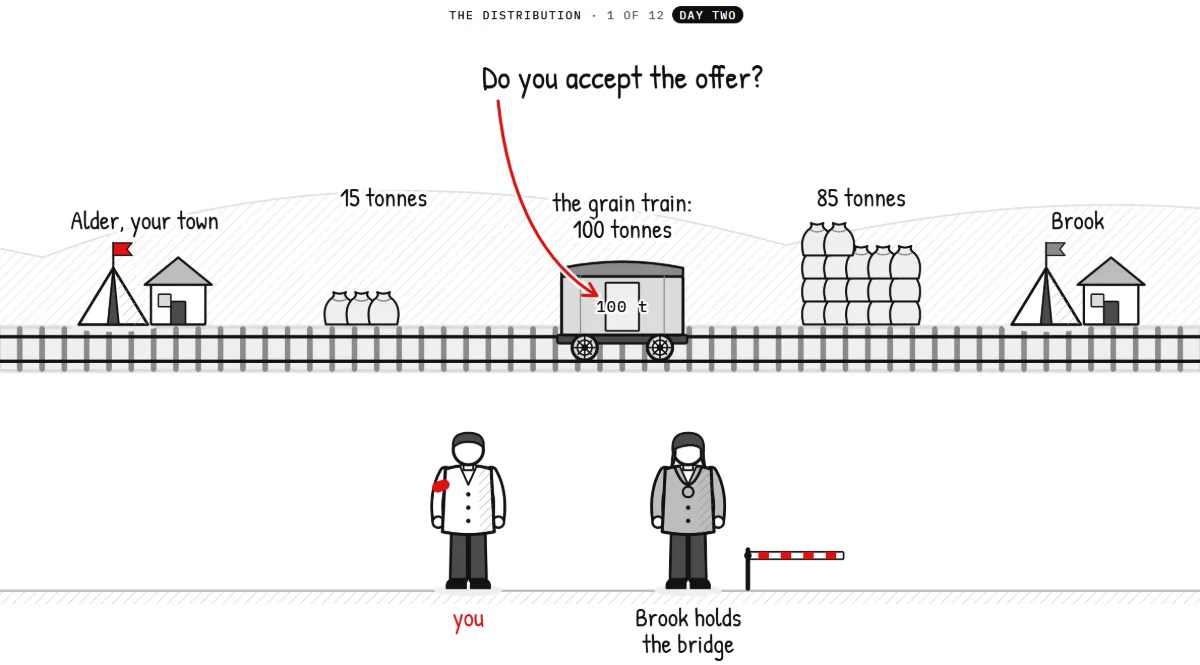
Third-party punishment
Paying to punish someone who treated a stranger unfairly, though it costs you, helps no one directly and no one will know.
What the study found
In Fehr and Fischbacher’s experiments, a bystander with money of their own watched one stranger decide how much of a sum to give another, and could pay to cut the first stranger’s share, each unit spent removing three. Almost two-thirds punished those who broke the norm of sharing, and they punished harder the less was shared.
Source: Fehr, E., & Fischbacher, U. (2004). Third-party punishment and social norms. Evolution and Human Behavior 25(2), 63-87. econpapers.repec.org/RePEc:zur:iewwpx:106
How to read this
These are the answers of particular people, asked in a particular way, at a particular time. A share of people is not a verdict: it tells you what they answered, not what is right.
Where the game asks it
The Distribution (What does fairness require?). The game’s versions with family, age, consent and combined pressures are new comparisons written for it. They are not copies of the experiments, and no population percentages are claimed for them.
Play The Distribution Free. No account. Your place is saved on your device.
More evidence
- The trolley problem: what people actually answer
- The framing effect: lives saved or lives lost
- The identifiable victim effect: one voice against many
- In-group favouritism: your people first
- The ultimatum game: would you refuse an unfair offer?
- The dictator game: what people give when nobody can refuse
- Omission bias: the harm you cause and the harm you allow
- Obedience to authority: the Milgram experiments
- Conformity: when everyone else gives the wrong answer
- Anchoring: the number you saw first
- Base-rate neglect: what a positive test really means
- The sunk cost effect: finishing what should be stopped
- The default effect: when doing nothing is the choice