The evidence
The trolley problem: what people actually answer
A runaway wagon will kill five people. You can turn it onto a side track, where it will kill one. Most people say you may. Now there is no side track: the only way to stop the wagon is to push one man into its path. The numbers are the same, five for one, and most people say you may not. Why the answer changes is the trolley problem.
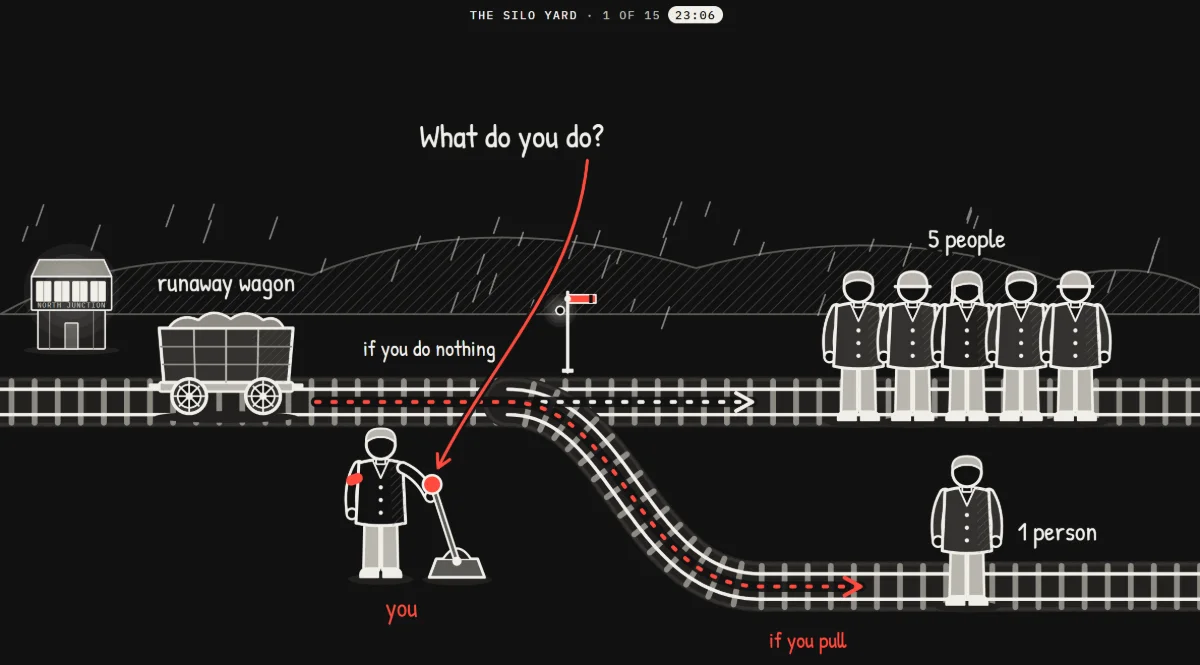
The trolley problem: the switch case
This is a moral dilemma, not an error: may you redirect a threat so that it kills one person instead of five? Philosophers have argued about cases like this one since 1967, and the argument is not over.
What the study found
In 2007, Hauser and colleagues asked web volunteers whether it was morally permissible to turn a runaway train onto a side track, killing one person instead of five. 89% said it was. The study counted only each volunteer’s first answer, and it asked whether the act was permissible, not what they would do themselves.
Source: Hauser, M., Cushman, F., Young, L., Jin, R. K.-X., & Mikhail, J. (2007). A dissociation between moral judgments and justifications. Mind & Language 22(1), 1-21. doi.org/10.1111/j.1468-0017.2006.00297.x
The trolley problem: the footbridge case (harm used as a means, by personal force)
Many who accept trading one life for five by throwing a switch refuse when the one must be pushed and used to stop the threat, though the numbers are the same.
What the study found
In the same 2007 study, only 11% judged it permissible to shove a heavy man off a footbridge into the path of a runaway train to save five, against 89% for turning the train onto a side track (2,646 first answers).
Source: Hauser, M., Cushman, F., Young, L., Jin, R. K.-X., & Mikhail, J. (2007). A dissociation between moral judgments and justifications. Mind & Language 22(1), 1-21. doi.org/10.1111/j.1468-0017.2006.00297.x
The trolley problem: the loop (harm used as a means, without a push)
In the loop the one worker is not a side effect: his body is what stops the wagon, as on the footbridge. But no one is pushed. The case asks whether what troubles people on the footbridge is using a person, or laying hands on him.
What the study found
In a 2020 study of 70,000 responses from 42 countries, the country-level average for endorsing the sacrifice was 81% in the plain switch case, 72% in the loop and 51% on the footbridge.
Source: Awad, E., Dsouza, S., Shariff, A., Rahwan, I., & Bonnefon, J.-F. (2020). Universals and variations in moral decisions made in 42 countries by 70,000 participants. PNAS 117(5), 2332-2337. doi.org/10.1073/pnas.1911517117
How to read this
These are the answers of particular people, asked in a particular way, at a particular time. A share of people is not a verdict: it tells you what they answered, not what is right.
Where the game asks it
The Junction (Whom would you sacrifice?). The game’s versions with family, age, consent and combined pressures are new comparisons written for it. They are not copies of the experiments, and no population percentages are claimed for them.
Play The Junction Free. No account. Your place is saved on your device.
More evidence
- The framing effect: lives saved or lives lost
- The identifiable victim effect: one voice against many
- In-group favouritism: your people first
- The ultimatum game: would you refuse an unfair offer?
- The dictator game: what people give when nobody can refuse
- Third-party punishment: paying to punish a stranger
- Omission bias: the harm you cause and the harm you allow
- Obedience to authority: the Milgram experiments
- Conformity: when everyone else gives the wrong answer
- Anchoring: the number you saw first
- Base-rate neglect: what a positive test really means
- The sunk cost effect: finishing what should be stopped
- The default effect: when doing nothing is the choice